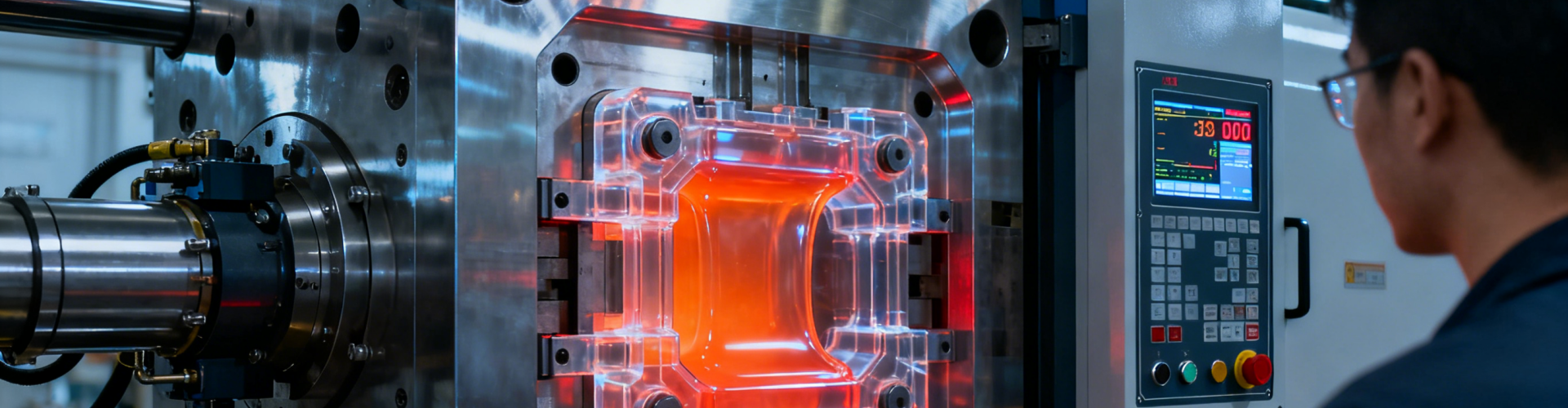
Banner Image


Overview: How Injection molding works?

The Basics Of Injection Molding Service

Injection molding is one of the most often-used manufacturing processes for creating plastic parts. Thanks to its high-precision, repeatability, and cost efficiency at scale, injection molding is used to make a variety of products and parts from the smallest medical insert up to large automotive & aerospace and defense parts. The injection molding process requires an injection molding machine, raw plastic material, and a machined mold. The raw plastic material is first melted in the injection unit and is then injected into the mold — most often machined from steel or aluminum — where it cools and solidifies into the final plastic part. The key steps in the injection molding process are clamping, injection, cooling, and ejection.


How Injection molding Works

The sequence of events during the injection mould of a plastic part is called the injection molding cycle. The key steps in the injection molding cycle are:
Clamping: The two sides of the mold are closed and clamped shut.
Injection: The material is fed into the machine and pushed towards the mold. While this is happening, the material is melted by heat and pressure. The plastic is then injected into the mold — this is called the “shot.”
Cooling: The plastic in the mold cools and solidifies into the shape of the part.
Ejection: After the part cools, it is ejected from the mold.
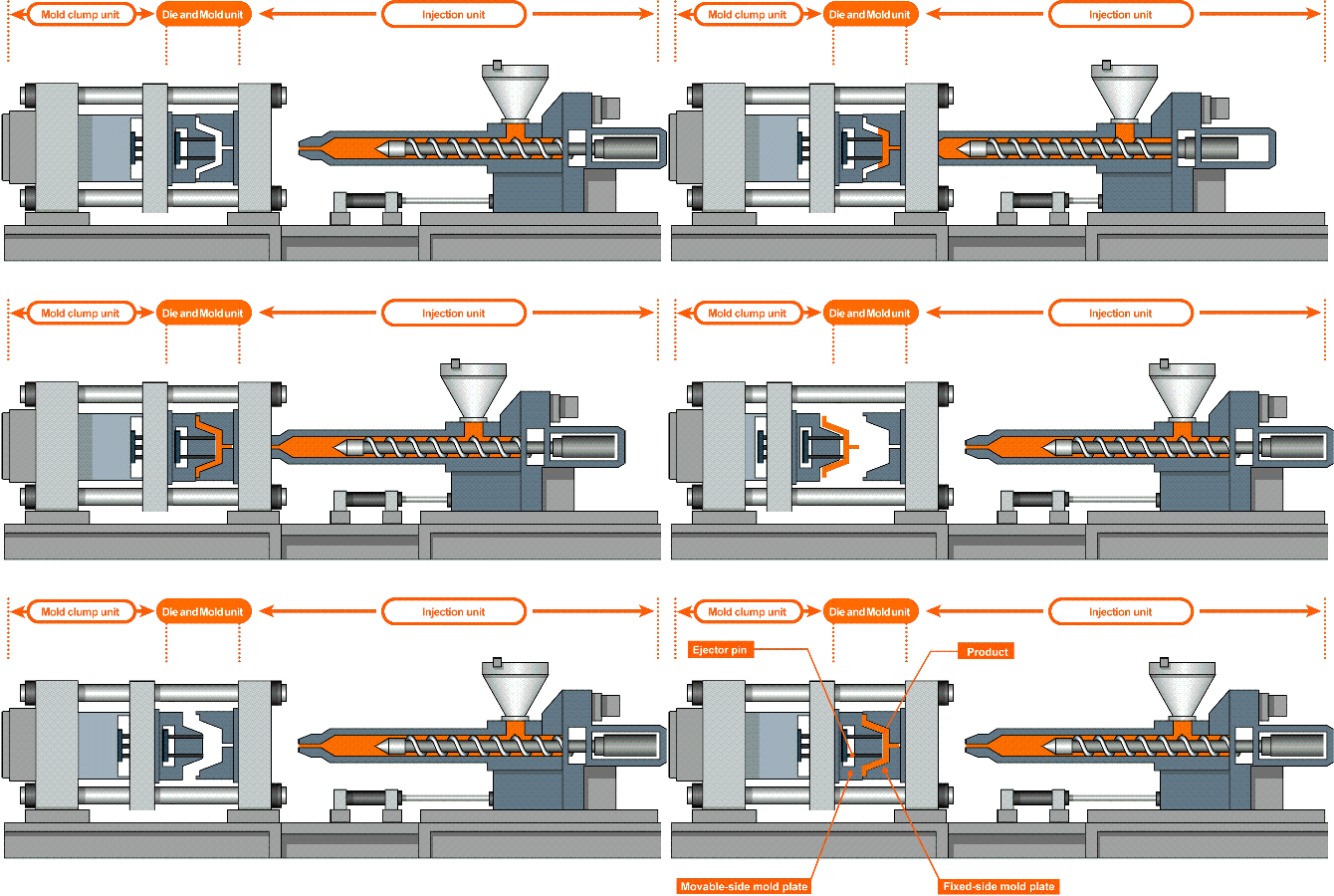
Injection Molding Cycle

Features of Injection Molding Service
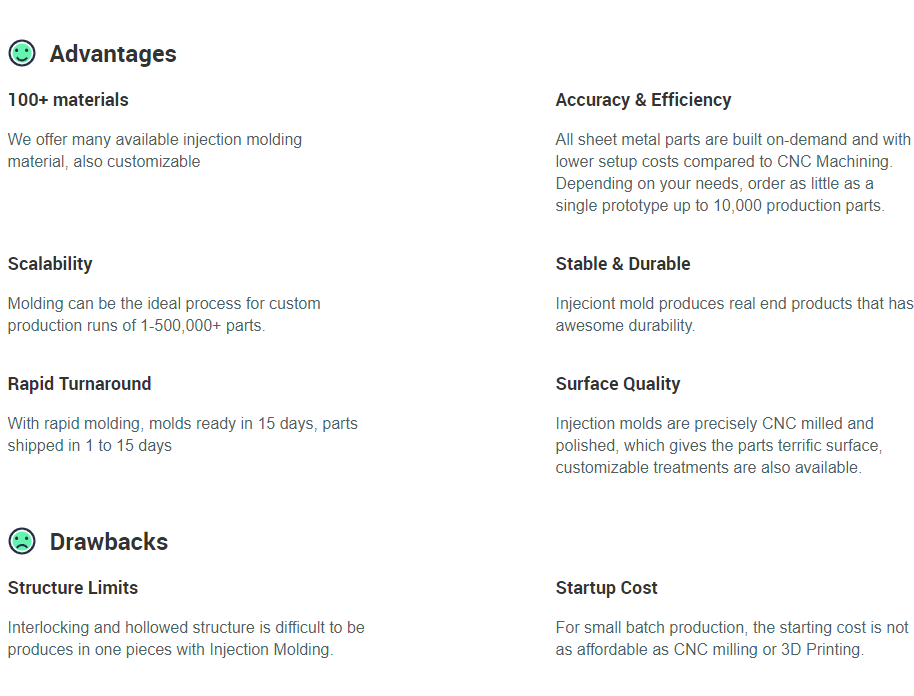
Injection Molding Processes
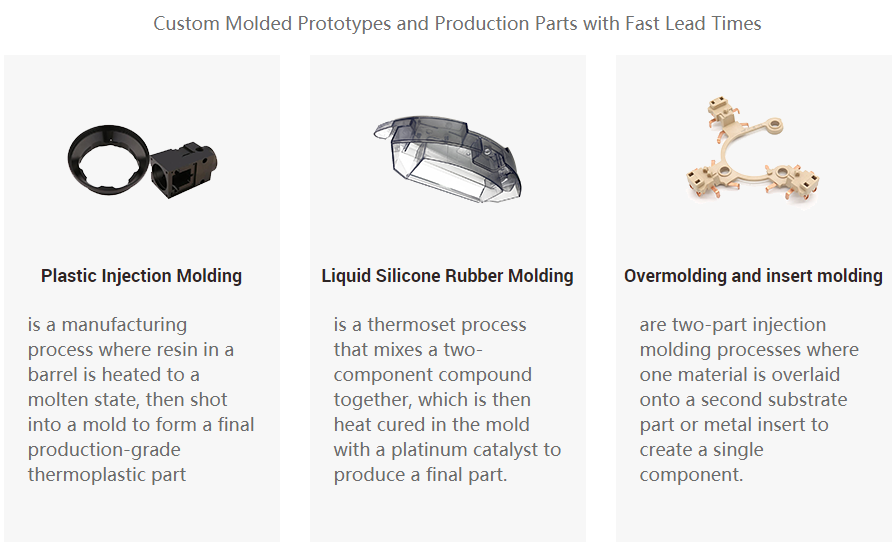
Injection Molding Materials

Rigid And Flexible Plastic Varieties,Rubber-Like Varieties

Hard Plastics

ABS | Acrylonitrile Butadiene Styrene
ASA | Acrylonitrile Styrene Acrylate
CA | Cellulose Acetate
COPO | Copolyester
PCT | Polycyclohexylenedimethylene Terephthalate
PPA | Polyphthalamide
HDPE | High-Density Polyethylene
PEEK
Polypropylene (PP)
Polycarbonate (PC)
PMMA | Polymethyl Methacrylate, Acrylic
Nylon 12(PA12)
Nylon 6/66(PA6/66)
Derlin (POM)
Teflon (PTFE)
PBT
PLA | Polylactic Acid
High-Density Polyethylene (HDPE)
PVC
PPS | Polyphenylene Sulfide, Ryton
Vespel (PI)
Torlon 4203 (PAI)
UPE/UHMW
PVDF
ULTEM (PEI)

Flexible Plastics

Polyethylene (PE)
Polystyrene (PS)
PET
EVA Foam
EPS Foam
PU Foam

Rubber-Like Varieties

TPE | Thermoplastic Elastomer, Santoprene
TPU | Thermoplastic Polyurethane (Shore A)
LSR | Liquid Silicone Rubber
PVC | Polyvinyl Chloride (Shore A)
POE | Polyolefin Elastomer
MPR | Melt Processable Rubber
EPDM | Ethylene Propylene Diene Monomer Rubber, Viton

Mixed plastic

PC-ABS | Polycarbonate-Acrylonitrile Butadiene Styrene
PC-PBT | Polycarbonate-Polybutylene Terephthalate
PC-PET | Polycarbonate-Polyethylene Terephthalate
PS-PPE | Polystyrene-Polyphenyl Ethers
PE-PS | Polyethylene-Polystyrene
PE-PP | Polyethylene-Polypropylene
PBT-PET | Polybutylene Terephthalate-Polyethylene Terephthalate


CONTACT US TO GET INSTANT QUOTE


Connectez-vous avec nous

Obtenir un devis en ligne dès aujourd'hui

Wells est votre partenaire de confiance et votre guichet unique pour la fabrication de circuits imprimés, l'approvisionnement en composants, l'assemblage de circuits imprimés et la fabrication électronique. Avec plus de 16 ans d'expérience, nous fournissons des circuits imprimés de haute qualité à des prix compétitifs à plus de 1000 clients dans le monde entier. Notre société est certifiée ISO9001:2015 et listée UL, et tous nos produits sont testés 100% E et inspectés par AOI et X-RAY pour répondre aux normes les plus élevées de l'industrie. N'hésitez pas à demander un devis instantané à notre équipe commerciale et nous nous occuperons du reste.

Contactez-nous dès maintenant →
Copyright 2009-2025 Tous droits réservés par
4th Floor,Building 12,No.3 Nangang Industial park ,Tangtou, Bao'an District, Shenzhen, Guangdong,China
Quote Icon